
Next month, India's homegrown Arjun tank will take on the new Russian T-90 in a long-awaited comparative trial.
Superimposing the India stick on the traditional carrots of aid, weaponry and undying friendship, is a measure of Washington's desperation in dealing with Pakistan's reluctance to crack down on Jihadi terrorism. Gates' new stance will also highlight America's shrinking interest in cultivating a benign image in Pakistan. Draining the abscess of radicalism is now a greater imperative.
Scrutinising the Sukhoi Corporation's work on the Fifth Generation Fighter Aircraft -- a project that India will soon sign up to co-develop -- gives one an idea of Russia's size, and its aerospace expertise.

On December 21, MHA promulgated a draft Arms and Ammunition Manufacturing Policy, which allows the Department of Industrial Policy & Promotion (Dipp) to issue licence to large private companies that are capable of producing advanced weapons, and invest over Rs 50 crore (Rs 500 million), to manufacture arms and ammunition to be "primarily supplied to the Central Paramilitary Forces, Defence and state governments on tendering basis".
The Indian Navy's prestigious Project 28, the programme to build four of the world's stealthiest anti-submarine corvettes, is on track to become even more cutting edge. By the end of this month, three international shipbuilders will be bidding to provide Kolkata-based Garden Reach Shipbuilders and Engineers with the technology to build a major part of the corvettes -- the entire superstructure -- with lightweight composites.

The INS Shivalik, now completing sea trials, is a world-class frigate built at Indian prices.

Since $4-5 billion (Rs 18,670-23,340 crore) will be needed to set up each nuclear reactor, capital costs alone add up to $200-250 billion (Rs 9,33,600-11,67,000 crore). Then there are fuel costs, nuclear waste disposal, reprocessing, consultants & advisors and, of course, the financial market aspects of raising all that money.
Tawang, after all, only became a part of India on February 6, 1951, when a Naga officer, Major Robert Kathing, leading a platoon of Assam Rifles, was welcomed by cheering Monpas after he crossed the Sela Pass and ordered the people of Tawang to stop paying taxes to the Tibetans. Until then, Tibetan officials had controlled the Tawang tract, a huge chunk of territory protruding south towards Tezpur.
The Indian Air Force's Sukhoi-30MKI fighter is a beast that is tamed only by technology. The aircraft's giant AL-31FP turbofan engines, which allow manoeuvres that no other fighter can dream of, are monitored by its pilots on high-tech computer screens called multi-function displays, or MFDs. A quick glance across the MFDs also provides information about on-board weapons and sensors, telling the pilots everything about how the aircraft is flying and fighting.
If India's military eventually plumps for primarily American equipment, a major reason will be: soldiers, sailors and airmen are completely sick of being gypped through poorly-framed acquisition contracts that entirely favour the foreign suppliers.
India's long-criticised Akash anti-aircraft missile is now blazing towards success. After years of rejection from the military, the Akash is being accepted as a world-class missile.
The undefined situation on the LAC contains the potential for an armed clash, something that would inflame current tensions
Veteran fighter pilots lament the end of the dogfight, the evocative name for a twisty, sky-ripping, adrenaline-packed aerial duel, in which the winner gets behind his opponent and shoots him down with a burst of cannon fire.Today, it is less about flying skill, cold nerve and highly-responsive aircraft; the modern-day dogfighting ace is an airborne video-game expert who uses radar to detect his foe at long ranges, and launch a beyond visual range missile.

The Advanced Systems Laboratory (ASL) in Hyderabad, which develops India's strategic (long-range, nuclear-tipped) missiles, has dramatically increased the options for its forthcoming Agni-5 missile by making it highly road-mobile, or easily transportable by road.
For the last eight years, since the Taliban fled from Kabul in November 2001, India has staunchly opposed a dialogue with any section of it. India's position has remained: there is no purpose in talking to the Taliban; there is no such thing as a moderate Taliban.

Viewed from the Indian side, China's infrastructure building along the LAC is a serious threat.

That investment in the Tejas programme is rooted in the navy's plan to operate both light and medium fighters off its aircraft carriers. The Naval LCA will supplement the heavier Russian MiG-29K, which has already been ordered from Russia.

The HAL-manufactured aircraft is around 580 kg overweight.
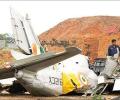
The long-delayed Hawk trainers, which began arriving in India in 2007, have improved advanced training for IAF flyers. But the crucial introduction to flying, conducted in antiquated HPT-32 Deepak and HJT-16 Kiran aircraft, is taking a growing toll on pilots' lives.
 © 2025 Rediff.com - Investor Information - Advertise with us - Disclaimer - Privacy Policy - Sitemap - Feedback - About us - Terms of use - Grievances